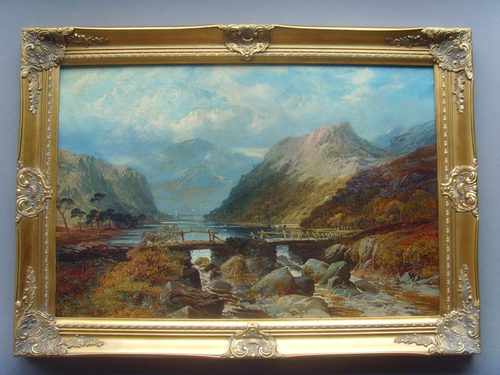
The image that I have chosen is a painting by H Clarence
Whaite. Whaite was born in Manchester in 1828 and was known for his work with
watercolours. In later life he became a leading figure in the formation of both
the Royal Cambrian Academy of Art and the Manchester Academy of Fine Arts. The
scene was painted (signed) in 1873 and is now held in Blackburn Museum on the
main staircase lit by tungsten lighting from the ceiling. This scene looks like
it depicts a winter scene showing the mountains in the distance snow-capped. The
painting appears to have been painted with oil paints, although from the
current view point on the staircase it is difficult to be sure about this.
The painting is a landscape of Thirlmere which is a lake, or
mere, south of Keswick in the Lake District, a very beautiful and romantic area
in North West England. Even though the title of the painting is Thirlmere the
image itself is more reflective of the valley than the lake. It is not a lake
anymore it is a reservoirs. The scene does not represent the rule of thirds
which is most commonly used in landscape paintings and photography. Although
the eye is drawn to the lake in the centre of the painting there is a
significant distraction in the mountain, or fell, toward the top of the
picture. The lake catches my eye most in this image even though it is almost
featureless, because it is directly in the middle of the painting.
I don’t think that this image has been copied from a
photograph, but he did most of his paintings in Wales - of subjects in Wales,
so this might have been the case. Whaite was about 45 years of age and seems to
be very experienced when he painted this scene because, in my view, it is not
like it has been painted by an amateur. The colours used are very cool which I
think suits this image. References refer to Whaite’s interest in colour theory
which is a guidance to colour mixing and which he often used in his paintings.
Although in this case he has not used, or seems not to have used, as he sometimes
did, spots of pure colour.

No comments:
Post a Comment